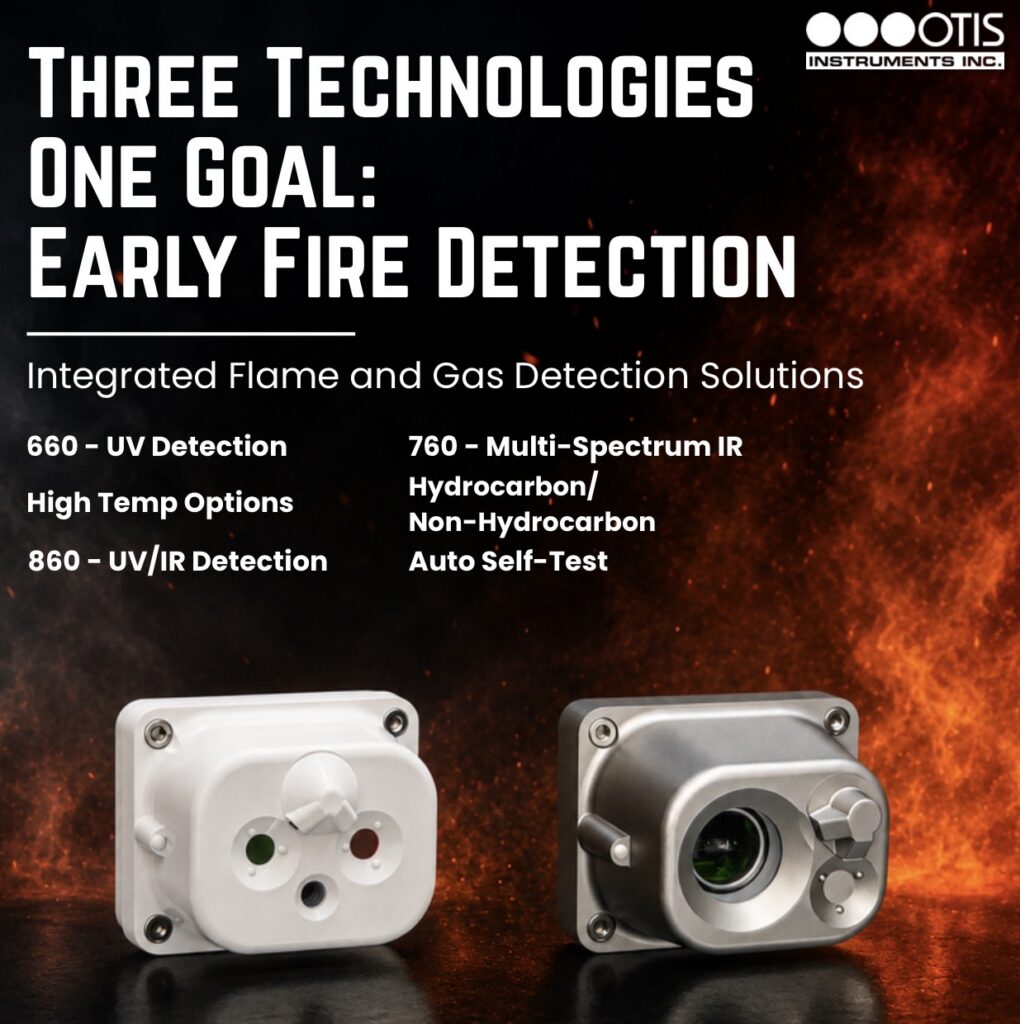
Industrial Flame Detection: Choosing the Right Technology for Your Application
A product spotlight by Otis Instruments, Inc.
In an industrial setting, the gap between a minor incident and a catastrophe often comes down to how fast a fire is caught. That’s the job flame detection systems quietly do every day; protecting personnel, equipment, production assets, and in many cases entire facilities. They’ve become a foundational part of any serious industrial safety program, and for good reason.
Think about the environments involved. Oil and gas, chemical processing, power generation, manufacturing, transportation — these are places where flammable liquids, combustible gases, and ignition sources are simply part of the landscape. In conditions like these, traditional smoke detection often can’t react quickly enough to head off serious consequences. Flame detectors take a different approach: they’re built to recognize the unique energy signatures a flame produces, which lets a facility respond fast and limit the damage. The catch is that not every detector is right for every job, so understanding how the technologies differ is where smart selection begins.
Why Flame Detection Matters
Industrial fires don’t wait around. They can develop rapidly, especially where hydrocarbons, fuels, solvents, or other combustible materials are present—and every extra second a fire goes undetected raises the stakes for your people, your operations, and your facility’s assets.
A modern flame detection system earns its place by delivering a number of clear advantages:
Faster detection and alarm activation
Improved personnel protection
Reduced equipment damage
Enhanced emergency response
Increased facility safety
Support for regulatory compliance
Reduced operational downtime
There’s an added benefit, too. When flame detectors are integrated with gas detection systems, the two together form a comprehensive hazard monitoring strategy that sharpens situational awareness and strengthens protection across the whole facility.
Understanding Flame Detection Technologies
Here’s the part worth slowing down for: flame detectors don’t all work the same way. Each technology is engineered around specific environmental conditions, fuel sources, and application requirements, which is exactly why there’s no single “best” detector.
Choosing the right one comes down to a handful of variables; how fast you need a response, what might interfere with detection, the conditions the device has to operate in, and the type of combustible material you’re guarding against. Three technologies cover the majority of industrial applications.
UV Flame Detection
Ultraviolet (UV) flame detectors watch for the ultraviolet radiation that combustion gives off. Because that UV energy appears almost the instant a fire starts, these detectors are exceptionally quick to respond. That speed is the whole point. UV detection tends to be the choice for applications where rapid detection is critical and where a potential ignition event has to be identified as fast as possible.
Common Applications
Fuel storage areas
Turbine enclosures
Chemical processing facilities
Engine test cells
Fuel transfer operations
Industrial equipment protection
Key Benefits
Extremely fast response
Effective for hydrocarbon fires
Reliable performance in controlled environments
Ideal for high-risk applications requiring immediate detection
When every second counts, UV flame detection can serve as a vital first line of defense.
Multi-Spectrum Infrared (IR) Flame Detection
Multi-Spectrum Infrared (MSIR) detectors take a more analytical approach, monitoring multiple infrared wavelengths that flames produce. By reading several portions of the infrared spectrum at once, they can tell the difference between a genuine fire and the environmental conditions that might otherwise trigger a nuisance alarm.
That discernment makes the technology especially well suited to outdoor or otherwise demanding industrial environments, where conditions can easily throw off less sophisticated detection.
Common Applications
Oil and gas production facilities
Compressor stations
Tank farms
Refining operations
Pipeline facilities
Petrochemical plants
Key Benefits
High immunity to false alarms
Excellent hydrocarbon fire detection
Reliable operation in harsh environments
Long-range detection capabilities
Suitable for outdoor applications
Since hydrocarbon fuels are everywhere in the energy sector, it’s no surprise that Multi-Spectrum IR has become one of the most widely used flame detection solutions in the oil and gas industry.
UV/IR Flame Detection
UV/IR flame detectors bring both worlds together, combining ultraviolet and infrared sensing in a single device. They require both methods to confirm a flame before sounding the alarm, which boosts reliability and cuts down on nuisance alarms.
That dual-spectrum approach strikes a useful balance—fast detection on one hand, alarm verification on the other—which is a big part of why it’s such a popular pick across a wide range of industrial applications.
Common Applications
Manufacturing facilities
Aircraft hangars
Power generation plants
Industrial processing operations
Equipment protection systems
Warehouses containing combustible materials
Key Benefits
Improved detection reliability
Reduced nuisance alarms
Fast response times
Versatile application flexibility
Effective across multiple industries
For facilities that need broad protection across varying operational environments, UV/IR technology often hits the sweet spot between performance and reliability.
Factors to Consider When Selecting a Flame Detector
Every facility brings its own safety challenges to the table, so before you settle on a technology, it’s worth working through a few key considerations.