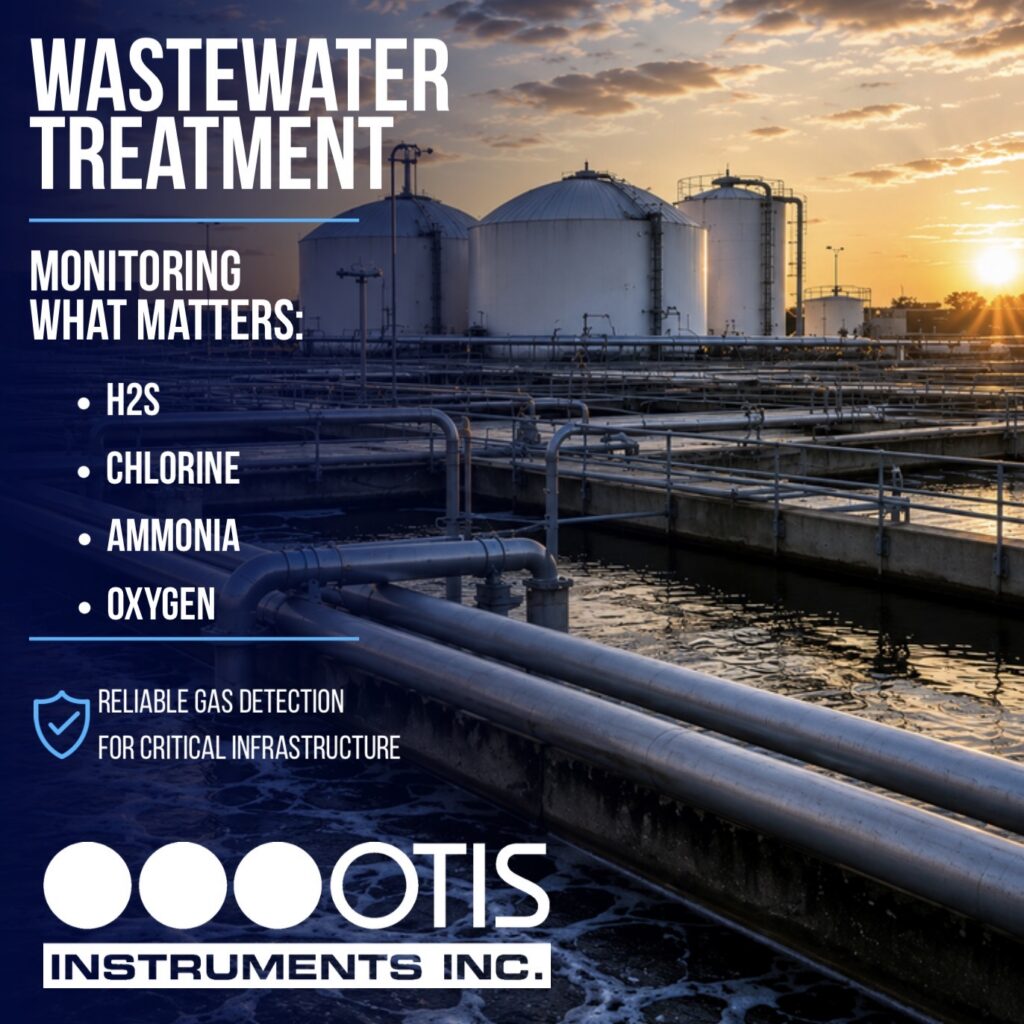
Gas Detection in Wastewater Treatment: Monitoring What Matters
An industry spotlight by Otis Instruments, Inc.
Wastewater treatment doesn’t get a lot of glamour, but it’s some of the most essential work there is and some of the most hazardous. Behind every clean discharge and every smoothly running treatment plant is a workforce operating around gases that can turn dangerous fast. That’s why reliable gas detection plays such a critical role in protecting personnel and keeping operations safe across wastewater and water treatment facilities.
The challenge is that no two facilities look exactly alike. Each one presents its own conditions, its own layout, and its own mix of hazards, which means the detection equipment has to be dependable enough to withstand demanding environments day after day. Here’s a closer look at the gases that matter most in these settings, and how the right monitoring approach helps keep people and infrastructure protected.
Why Gas Detection Matters in Wastewater Treatment
Treatment facilities are full of the ingredients for gas hazards: decomposing organic material, chemical disinfection processes, enclosed tanks, and confined spaces where the air isn’t always what it should be. Any one of these can put workers at risk, and often they overlap.
Reliable gas detection gives operators continuous visibility into those conditions, so a problem gets caught early while there’s still time to respond rather than after someone has walked into it. For a safety program, that early warning is the whole ballgame.
The Gases Operators Monitor
Across wastewater and water treatment facilities, operators commonly monitor for a handful of hazardous gases along with oxygen deficiencies. Each brings its own risk profile.
Hydrogen Sulfide (H₂S)
Hydrogen Sulfide (H₂S) is practically synonymous with wastewater. It forms as organic matter breaks down, and it’s notorious for its rotten-egg smell at low concentrations. Though, relying on your nose is dangerous, since H₂S can deaden the sense of smell at higher levels. Hydrogen sulfide is highly toxic and tends to collect in low lying and confined areas, which makes continuous monitoring essential.
Chlorine (Cl₂)
Chlorine (Cl₂) shows up widely in water treatment, where it’s used for disinfection. It’s effective at what it does, but it’s also a strong respiratory irritant and toxic at elevated concentrations. Keeping tabs on Cl₂ levels helps protect the workers handling and storing it.
Ammonia (NH₃)
Ammonia (NH₃) is another gas operators watch for in these environments. Exposure can pose real health risks, so dependable NH₃ monitoring is an important layer of protection wherever it may be present.
Oxygen (O₂) Deficiency
Not every hazard is a toxic gas; sometimes it’s the absence of enough breathable air. Oxygen (O₂) deficiency is a serious concern in tanks, wells, and other confined spaces, where O₂ can be displaced without any obvious warning. Monitoring oxygen levels is critical before and during entry into these areas.
Detection Built for Demanding Conditions
Knowing which gases to watch for is only half the equation. The other half is deploying equipment that can hold up in the field and fit the way a specific facility is laid out.
Otis Instruments’ 6000 XP Series and Cube systems provide flexible gas monitoring solutions designed to meet the needs of wastewater applications. Depending on the facility setup, these systems can be paired with remote sensor kits, allowing sensors to be strategically placed exactly where monitoring is needed most while keeping the controls accessible. That flexibility matters in a treatment plant, where the riskiest spots aren’t always the most convenient ones to reach.
Protecting People, Assets, and Infrastructure
From treatment plants to processing areas, Otis Instruments is committed to delivering reliable WireFree and fixed gas detection technology that helps protect people, assets, and critical infrastructure. Having both wireless and fixed options on the table means a facility can build a monitoring strategy around its real world constraints rather than forcing everything into a single mold.
Safer facilities start with smarter monitoring. By keeping continuous watch over gases like H₂S, Cl₂, and NH₃—and staying alert to O₂ deficiency—wastewater and water treatment operations can protect the people who keep them running and the infrastructure communities depend on.