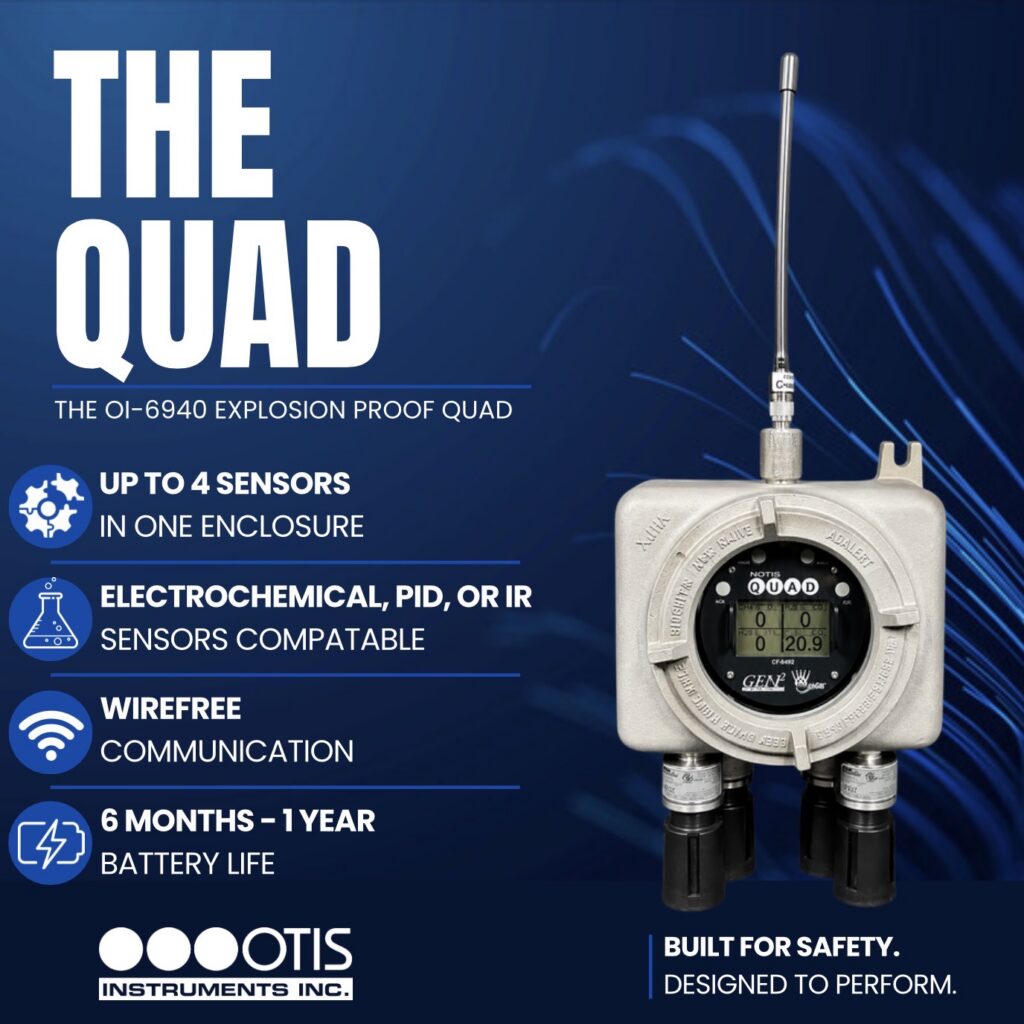

One Enclosure, Four Sensors: How the OI-6940 Explosion Proof Quad Simplifies Industrial Gas Detection
A product spotlight from Otis Instruments, Inc.
Why Reliable Gas Detection Matters in Hazardous Environments
In facilities where combustible or toxic gases are part of daily operations, dependable monitoring is not a convenience, it is a core safety requirement. Oil and gas sites, chemical processing plants, and manufacturing floors all share the same challenge: detecting hazardous gases early enough to protect people, equipment, and production uptime.
The difficulty is that traditional gas detection often means installing and maintaining multiple separate units, running extensive wiring, and managing a tangle of devices across a single area. That added complexity raises both installation costs and the chance of something being overlooked in the field.
The OI-6940 Explosion Proof Quad from Otis Instruments, Inc. was designed to address exactly that problem. It consolidates advanced monitoring into one rugged, compact unit built for demanding conditions. An explosion proof gas detector that does the work of several devices at once.
Four Sensors, One Enclosure
The defining feature of the OI-6940 is its capacity to monitor up to four sensors within a single enclosure. Instead of mounting and wiring separate detectors for each gas you need to track, you can manage multiple readings from one location.
This multi-sensor approach delivers a few practical advantages:
- Lower installation footprint. Fewer enclosures mean less mounting hardware, less conduit, and a cleaner installation overall
- Simplified maintenance. Technicians service one unit rather than coordinating across several scattered devices.
- Broader coverage per location. A single point can watch for multiple gas hazards at once, improving overall operational awareness.
For teams managing safety across large or complex sites, consolidating detection into fewer units reduces both cost and the everyday burden of upkeep.
Flexible Sensor Options for Different Applications
No two facilities monitor for the exact same set of gases, so the OI-6940 is compatible with three common sensor technologies:
- Electrochemical sensors, well suited to detecting toxic gases such as hydrogen sulfide or carbon monoxide.
- Photoionization detector (PID) sensors, used to measure volatile organic compounds.
- Infrared (IR) sensors, a strong choice for combustible gases and applications where long sensor life and resistance to poisoning are priorities.
This flexibility lets you configure the unit around your specific hazards rather than forcing your application to fit a fixed sensor set. As monitoring needs change, the platform can be adapted accordingly.
Explosion Proof Design Built for Demanding Conditions
The “Explosion Proof” in the product name reflects how the unit is engineered. Its enclosure is built to contain an internal ignition and prevent it from triggering a larger event in the surrounding atmosphere. The standard expectation for equipment operating in classified hazardous areas.
That rugged construction means the OI-6940 is suited to the harsh, real-world settings where gas detection matters most: outdoor installations, high-vibration environments, and areas exposed to demanding industrial conditions. It is, in short, built for safety and designed to perform.
WireFree Communication for Streamlined Integration
Running cable across a facility is one of the most time-consuming and expensive parts of deploying a detection system. The OI-6940 includes WireFree communication capabilities, allowing it to transmit data without the extensive wiring a hardwired system would require.
For operators, wireless gas monitoring translates into faster deployment, lower installation cost, and the ability to place detectors where they are needed most. Even in locations where running cable would be impractical. It also makes expanding or reconfiguring a monitoring network considerably easier over time.
Long Battery Life That Reduces Field Visits
Because the OI-6940 is a wireless unit, power management is a key consideration. The detector delivers a battery life of six months to one year, depending on configuration and use.
Extended battery life means fewer trips into the field to swap or recharge units, which keeps technicians safer and reduces the labor associated with routine maintenance. In remote or hard-to-reach installations, that interval makes a meaningful difference in total cost of ownership.
Built for the Industries that Depend on Detection
Dependable gas detection is critical across a range of sectors, and the OI-6940 is designed to serve them:
- Oil and gas operations, both upstream and downstream
- Chemical processing facilities
- Manufacturing environments
- Other industrial operations where hazardous gases are present
In each of these settings, the goal is the same; improve operational awareness while reducing complexity in the field. By combining multi-sensor capability, flexible sensor options, explosion proof construction, and wireless communication in one unit, the OI-6940 helps facilities meet that challenge.
Engineered for Performance, Built with Safety in Mind
The OI-6940 Explosion Proof Quad reflects a straightforward philosophy: powerful monitoring should not require a complicated, costly installation. By bringing up to four sensors, configurable sensor technologies, rugged explosion proof design, and WireFree communication together in a single enclosure, Otis Instruments offers a gas detection solution built for the realities of industrial work.
If your facility relies on dependable gas detection, the OI-6940 is engineered to deliver it, without the added complexity.