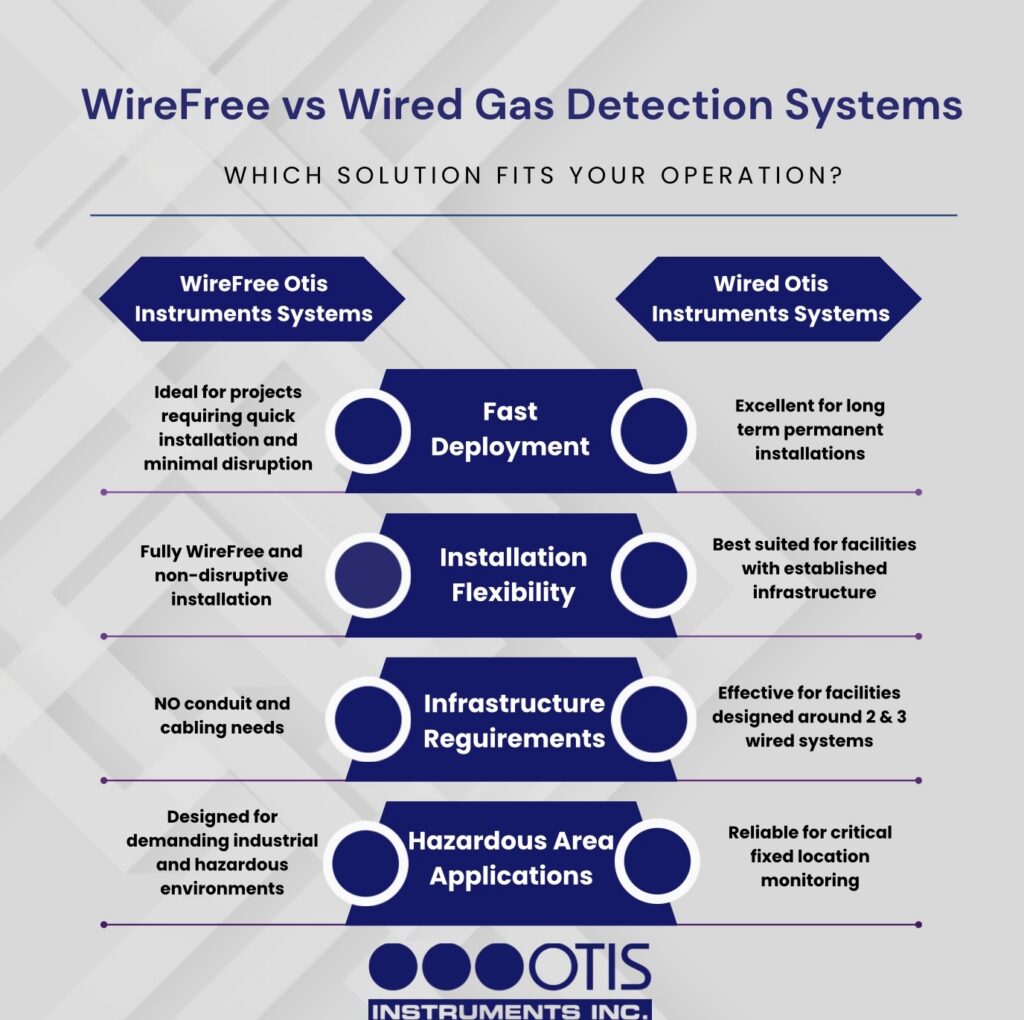

WireFree vs Wired Gas Detection
Choosing the Right Solution for Your Facility
Industrial facilities rely on reliable gas detection systems to protect personnel, maintain compliance, and prevent costly downtime. As technology continues to evolve, facility managers are increasingly faced with an important decision: Should you choose a WireFree gas detection system or a traditional wired gas detection system?
The answer depends on your facility’s infrastructure, monitoring requirements, installation timeline, and long term operational goals.
In this guide, we’ll compare WireFree gas detection systems and wired gas detection systems to help you determine the best fit for your operation.
Understanding Gas Detection Systems
Gas detection systems are designed to continuously monitor hazardous gases and provide early warning alerts when unsafe conditions occur. These systems are commonly used in:
- Oil and gas facilities
- Chemical processing plants
- Manufacturing facilities
- Wastewater treatment plants
- Power generation sites
- Food processing facilities
- Hazardous area applications
The effectiveness of a gas detection system often depends not only on the sensor technology but also on how the devices communicate throughout the facility.
What Is a WireFree Gas Detection System?
WireFree gas detection systems use radio communication to transmit gas concentration data, alarms, and status information without the need for extensive wiring or conduit installation.
Modern WireFree systems are designed for industrial environments and can provide reliable monitoring while significantly reducing installation complexity.
Benefits of Wireless Gas Detection
1. Fast Deployment
One of the biggest advantages of WireFree gas detection is speed of installation.
Because there is no need to run conduit, trench cable, or modify existing infrastructure, facilities can deploy monitoring systems much faster than traditional wired solutions.
This makes WireFree systems ideal for:
- Facility expansions
- Temporary monitoring projects
- Remote locations
- Turnaround and maintenance events
2. Installation Flexibility
WireFree gas detectors can be placed in locations where running cable would be difficult or cost prohibitive.
This flexibility allows facilities to:
- Expand monitoring coverage easily
- Relocate detectors as operational needs change
- Add additional monitoring points without major infrastructure modifications
3. Reduced Infrastructure Requirements
Traditional wired systems often require:
- Conduit installation
- Cable trays
- Trenching
- Junction boxes
- Additional labor costs
WireFree systems eliminate many of these requirements, helping reduce installation costs and minimize disruptions to ongoing operations.
4. Ideal for Hazardous Industrial Environments
Many WireFree gas detection systems are designed specifically for demanding industrial applications, including hazardous and classified areas where flexibility and scalability are critical.
What Is a Wired Gas Detection System?
Wired gas detection systems use physical cabling to connect gas detectors to controllers, monitoring stations, or plant control systems.
For decades, wired systems have been the standard solution across industrial facilities due to their reliability and long-term stability.
Benefits of Wired Gas Detection
1. Excellent for Permanent Installations
Wired systems are often preferred for facilities with established infrastructure and long term monitoring requirements.
These systems are particularly well suited for:
- Large industrial plants
- Refineries
- Chemical processing facilities
- Permanent fixed monitoring locations
2. Proven Reliability
A wired communication path provides consistent connectivity and predictable performance, making it a trusted solution for critical monitoring applications.
3. Integration with Existing Infrastructure
Many facilities already have wiring pathways, conduit systems, and centralized control networks in place.
In these situations, expanding an existing wired gas detection network may be the most practical approach.
4. Effective for Fixed Monitoring Locations
When gas detection points are unlikely to change over time, wired systems offer a stable long term solution that can operate for years with minimal infrastructure changes.
Wireless vs. Wired Gas Detection: Key Comparison
Feature | WireFree Gas Detection | Wired Gas Detection |
Installation Speed | Fast | Moderate to Long |
Infrastructure Requirements | Minimal | Extensive |
Expansion Flexibility | High | Moderate |
Facility Disruption | Minimal | Higher |
Permanent Installations | Good | Excellent |
Remote Monitoring Locations | Excellent | Limited |
Existing Infrastructure Integration | Moderate | Excellent |
Fixed Monitoring Applications | Good | Excellent |
Which Gas Detection System Is Right for Your Facility?
When evaluating gas detection technologies, consider the following questions:
Choose WireFree Gas Detection If:
- You need rapid deployment.
- Running conduit and cable is difficult or expensive.
- Your facility is expanding frequently.
- Monitoring requirements may change over time.
- You need coverage in remote or temporary locations.
Choose Wired Gas Detection If:
- You have an established infrastructure.
- Monitoring points are permanent.
- You are building a long-term fixed monitoring network.
- Reliability and continuous connectivity are top priorities.
- The facility is already designed around wired instrumentation systems.
Why Many Facilities Are Adopting Hybrid Gas Detection Systems
Increasingly, industrial facilities are combining both technologies.
A hybrid approach allows organizations to use:
- Wired systems for critical permanent monitoring points
- WireFree systems for expansion areas and difficult to reach locations
This strategy maximizes coverage while controlling installation costs and maintaining operational flexibility.
Gas Detection Solutions from Otis Instruments
At Otis Instruments, we understand that no two facilities have identical monitoring requirements. That’s why we offer both WireFree gas detection systems and wired gas detection solutions designed to support safer, smarter industrial operations.
Whether you’re building a new monitoring network, expanding an existing system, or evaluating options for a hazardous area application, selecting the right technology can improve safety, increase efficiency, and reduce installation challenges.
Our team can help you determine the best solution based on your facility layout, operational goals, and monitoring requirements.