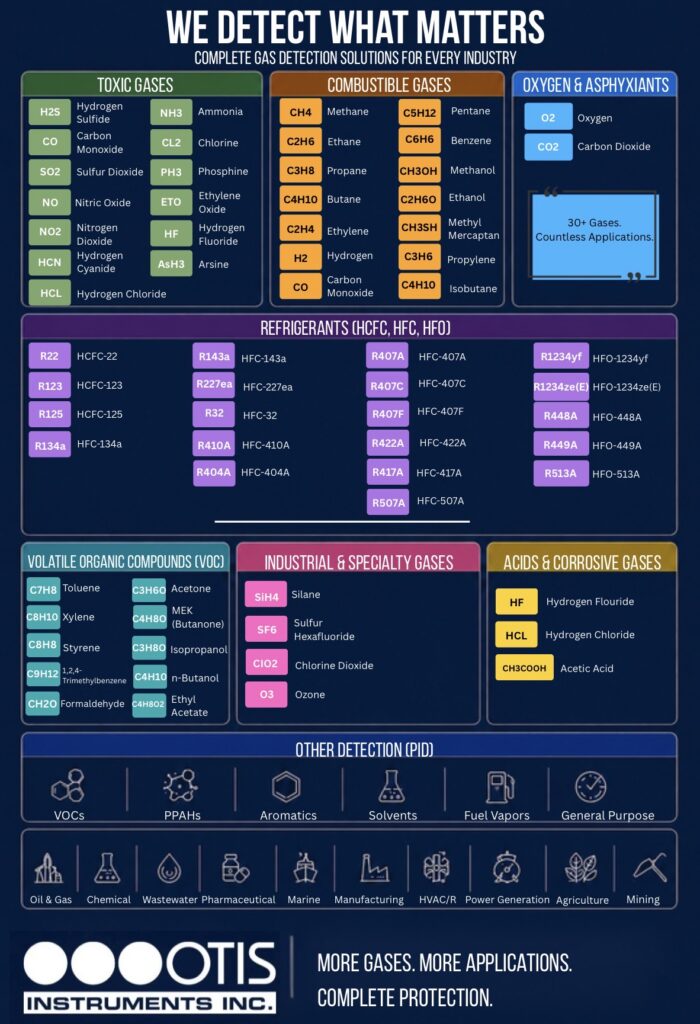
We Detect What Matters: The Full Range of Gases Otis Instruments Detects
When most people picture gas detection, they think of one or two gases. Carbon Monoxide (CO), maybe, or Methane (CH₄). At Otis Instruments, we think much bigger.
Real facilities rarely deal with just one hazard. A single site might have toxic gases in one area, combustible hydrocarbons in another, refrigerant lines running through a third, and volatile organic compounds coming off a process somewhere else. That is why our detection solutions are built to cover the hazards that matter most across virtually every industry, from toxic and combustible gases to refrigerants, volatile organic compounds (VOCs), oxygen monitoring, corrosive gases, and PID applications.
Whether you are protecting personnel in an oil and gas facility, monitoring refrigerant leaks in a food processing plant, detecting VOCs in a chemical facility, or keeping operations safe in a wastewater treatment plant, there is an Otis Instruments solution suited to your application.
Our product portfolio supports detection for dozens of gases and compounds. Here is a closer look at what that covers.
Toxic Gases
These are the gases that threaten health directly, often at very low concentrations, which is exactly why continuous monitoring is so important.
Hydrogen Sulfide (H₂S)
Carbon Monoxide (CO)
Sulfur Dioxide (SO₂)
Nitric Oxide (NO)
Nitrogen Dioxide (NO₂)
Hydrogen Cyanide (HCN)
Hydrogen Chloride (HCl)
Ammonia (NH₃)
Chlorine (Cl₂)
Phosphine (PH₃)
Ethylene Oxide (ETO)
Hydrogen Fluoride (HF)
Arsine (AsH₃)
Combustible Gases and Hydrocarbons
Flammable gases carry fire and explosion risk, so keeping an accurate read on their concentrations is critical to safe operations.
Methane (CH₄)
Ethane (C₂H₆)
Propane (C₃H₈)
Butane (C₄H₁₀)
Ethylene (C₂H₄)
Hydrogen (H₂)
Carbon Monoxide (CO)
Pentane (C₅H₁₂)
Benzene (C₆H₆)
Methanol (CH₃OH)
Ethanol (C₂H₆O)
Methyl Mercaptan (CH₃SH)
Propylene (C₃H₆)
Isobutane (C₄H₁₀)
Oxygen and Asphyxiants
Sometimes the danger is not a toxic gas at all, but too little breathable air or a gas that pushes oxygen out of a space.
Oxygen (O₂)
Carbon Dioxide (CO₂)
Refrigerants (HCFC, HFC, HFO)
Cooling and refrigeration systems rely on a wide range of refrigerants, and a leak can affect safety, product quality, and compliance all at once. We cover HCFC, HFC, and HFO refrigerants, including:
R22 (HCFC-22)
R123 (HCFC-123)
R125 (HCFC-125)
R134a (HFC-134a)
R143a (HFC-143a)
R227ea (HFC-227ea)
R32 (HFC-32)
R410A (HFC-410A)
R404A (HFC-404A)
R407A (HFC-407A)
R407C (HFC-407C)
R407F (HFC-407F)
R422A (HFC-422A)
R417A (HFC-417A)
R507A (HFC-507A)
R1234yf (HFO-1234yf)
R1234ze(E) (HFO-1234ze(E))
R448A (HFO-448A)
R449A (HFO-449A)
R513A (HFO-513A)
Volatile Organic Compounds (VOCs)
VOCs turn up across manufacturing, laboratories, and chemical processing, and many of them pose real health and safety concerns.
Toluene (C₇H₈)
Xylene (C₈H₁₀)
Styrene (C₈H₈)
1,2,4-Trimethylbenzene (C₉H₁₂)
Formaldehyde (CH₂O)
Acetone (C₃H₆O)
MEK / Butanone (C₄H₈O)
Isopropanol (C₃H₈O)
n-Butanol (C₄H₁₀)
Ethyl Acetate (C₄H₈O₂)
Industrial and Specialty Gases
Certain processes involve specialized gases that call for dedicated detection.
Silane (SiH₄)
Sulfur Hexafluoride (SF₆)
Chlorine Dioxide (ClO₂)
Ozone (O₃)
Acids and Corrosive Gases
Corrosive gases threaten both personnel and equipment, so early detection protects your people and your infrastructure.
Hydrogen Fluoride (HF)
Hydrogen Chloride (HCl)
Acetic Acid (CH₃COOH)
PID-Based Detection
Photoionization detection (PID) widens the net to a broad set of compounds that other sensor types can miss, covering:
VOCs
PPAHs
Aromatics
Solvents
Airborne fuel compounds
General-purpose monitoring
One Goal Across Every Industry
This breadth is why you will find Otis Instruments detection across so many settings: oil and gas, chemical, wastewater, pharmaceutical, marine, manufacturing, HVAC/R, power generation, agriculture, and mining.
No matter the industry, the goal stays the same: reliable gas detection solutions that help protect people, assets, and operations. More gases. More applications. Complete protection.
If you are wondering which gases are the critical ones to monitor in your facility, that is exactly the conversation we are built for.